
GPS Tracker: How Does It Work and Why Have One in 2026?
First, the GPS tracker has become an essential tool for fleet professionals and individuals concerned with securing their vehicles. Indeed, whether it's to prevent theft, optimize routes, or comply with CNIL obligations, understanding how a GPS tracker works has become indispensable in 2026.
⚡ The Essentials in 30 Seconds
- GPS trackers use GPS satellites to calculate their position with 2 to 5 meters accuracy.
- 3 main types: OBD (plug-and-play), magnetic (no installation), wired (pro installation).
- Integrated SIM card to transmit data to a cloud server in real-time.
- Indicative prices: hardware €60 to €250, subscription €5 to €25/month depending on features.
- Legality: Authorized in France if you comply with CNIL obligations (written information, register, legitimate purpose).
- Installation: 30 seconds for an OBD, 2 hours for a wired one at a professional installer.
What is a GPS tracker?
First, a GPS tracker is a small electronic device installed in a vehicle that receives signals from satellites to determine its precise geographical position. Then, it transmits this position to a server via an integrated SIM card, allowing the user to view the vehicle's location in real-time from a computer or smartphone.
Furthermore, modern GPS trackers are no longer limited to simple location tracking. They now integrate many advanced features: shock detection, zone alerts, consumption measurement, driving monitoring, geofencing, and many others. Thus, they have become true management assistants for professional fleets.
In Summary
A GPS tracker is a device that combines 3 technologies: satellite reception (GPS), cellular transmission (4G SIM card), and software interface (web and mobile). As a result, you have a complete real-time tracking system.
How Does a GPS Tracker Work in 3 Steps?
First, here's a detailed, step-by-step explanation of how a GPS tracker works.

1. GPS Satellites
First, the GPS system relies on a constellation of 31 satellites orbiting Earth at an altitude of approximately 20,200 km. The tracker captures signals from at least 4 satellites simultaneously to calculate its position by triangulation. Thus, the higher the number of visible satellites, the better the location accuracy (up to 2 meters in open areas).
Furthermore, since 2020, modern GPS trackers also use the European (Galileo), Russian (GLONASS), and Chinese (BeiDou) constellations to further improve signal accuracy and availability, especially in dense urban environments.
2. Data Transmission
Next, once the position is calculated, the GPS tracker sends this data via the mobile network (3G, 4G LTE, or even 5G for recent models). A SIM card is integrated into the device — it is often multi-operator (M2M or IoT) to ensure optimal coverage throughout Europe.
Consequently, the GPS coordinates arrive on EZTrack servers in just a few seconds. Moreover, the transmission frequency is configurable: every 30 seconds for real-time tracking, every minute for battery optimization, or only upon an event (theft, departure, zone alert).
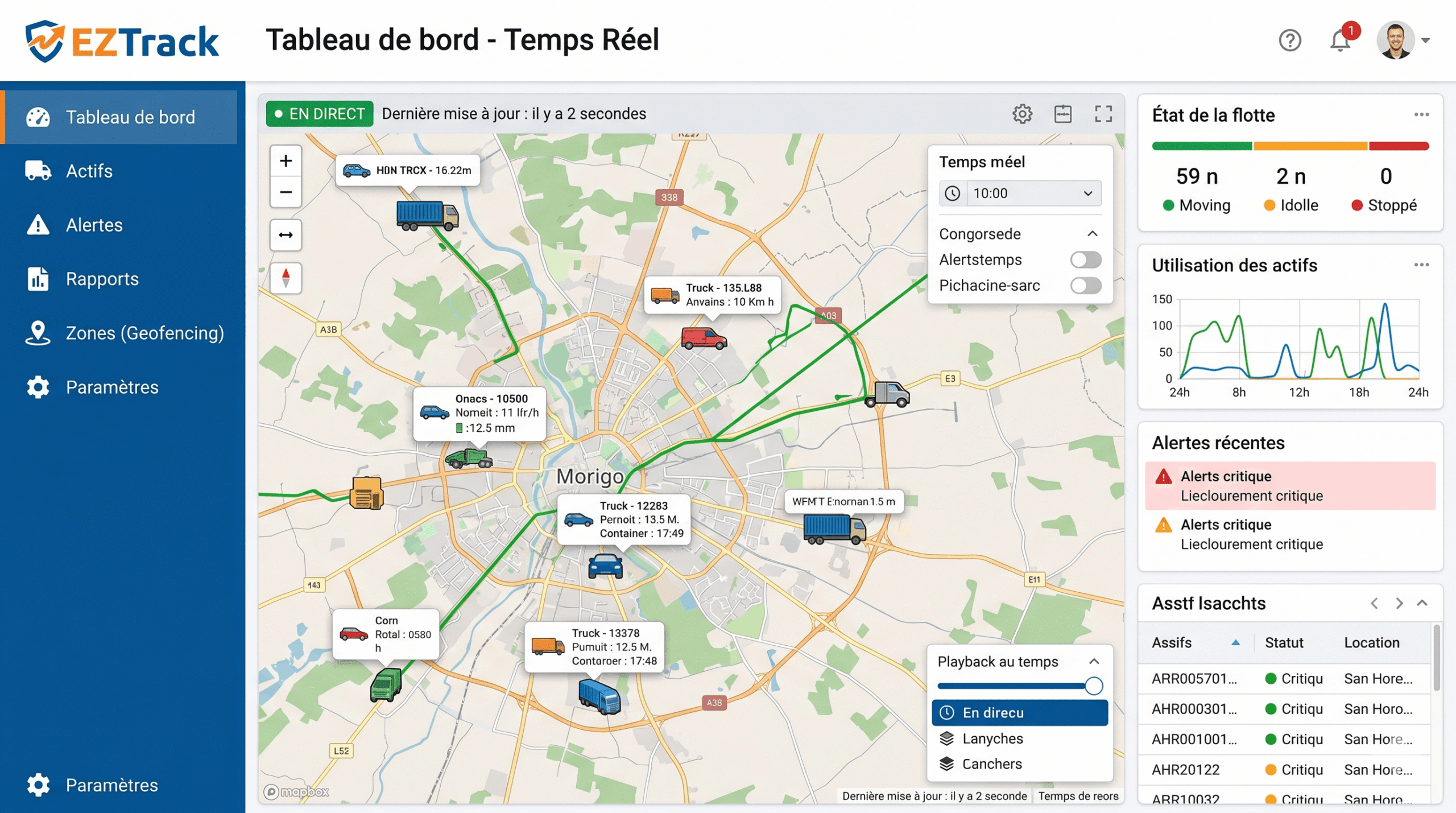
3. The Monitoring Interface
Finally, the user can view the vehicle's real-time position from:
- A web interface (map dashboard)
- A mobile application (iOS and Android)
- REST APIs for integration with your ERP or TMS
Thus, you have a 360° view of your fleet: current positions, trip history, driving statistics, real-time alerts.
Did you know that?
First, the American GPS system (NAVSTAR) belongs to the U.S. Department of Defense and has been free for civilian use since 2000. Europe then developed its own independent system, Galileo, operational since 2016, with native accuracy below one meter — more precise than standard GPS.
OBD, Magnetic, or Wired GPS Tracker: Which Type to Choose?
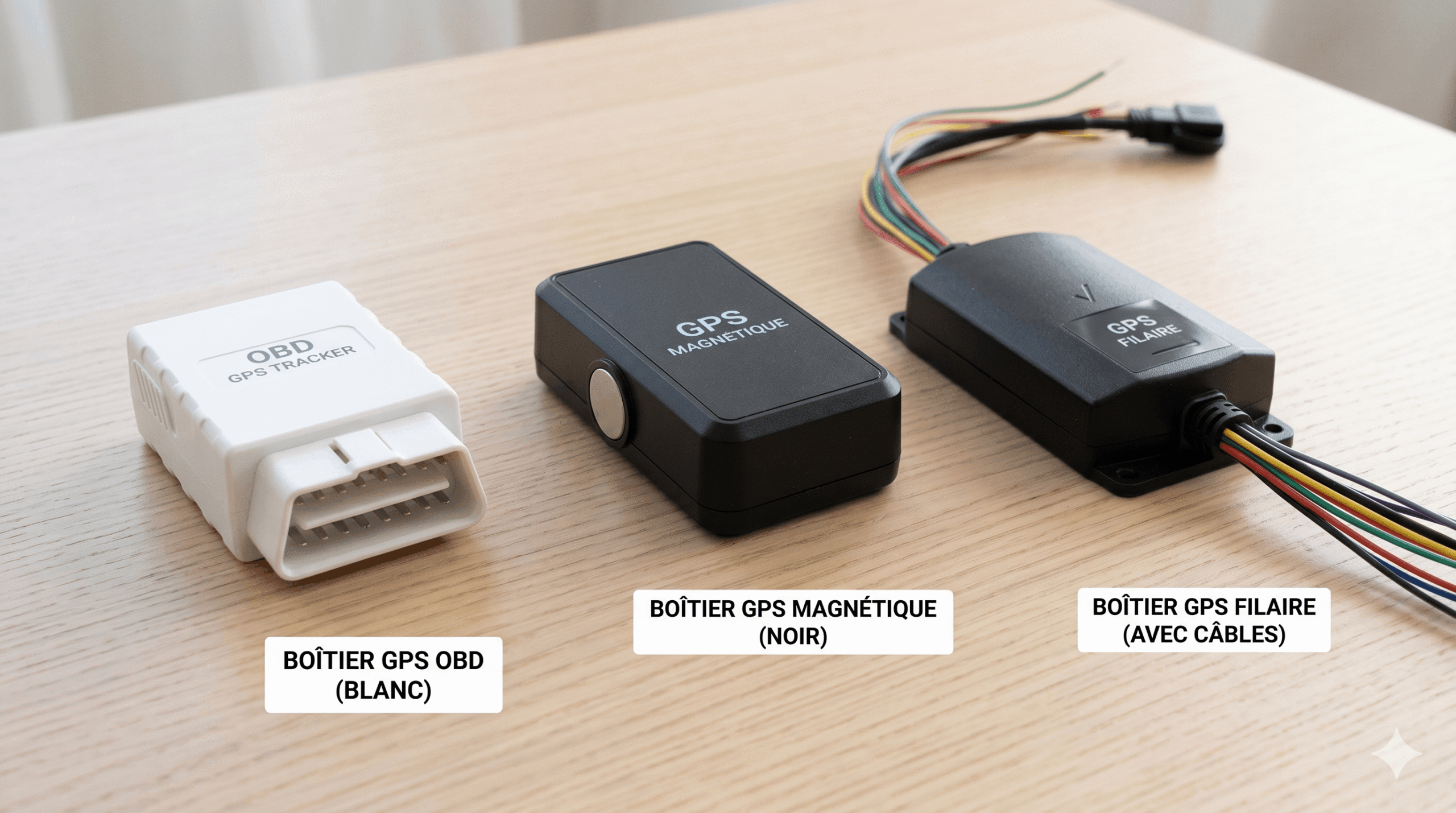
First, there are three main families of GPS trackers for vehicles, each with its advantages and constraints. Therefore, your choice will depend on your use (pro vs. personal), your budget, and the desired installation time.
1. OBD GPS Tracker (plug-and-play)
The OBD GPS tracker plugs directly into the vehicle's OBD-II diagnostic port (present on all vehicles since 2001). Installation literally takes 30 seconds: you plug the device under the steering wheel, and you're done.
- ✅ Immediate installation without tools or technical skills
- ✅ Retrieves engine data (mileage, consumption, fault codes)
- ✅ Direct power from the vehicle (no battery to recharge)
- ⚠ Visible and easily unplugged by the driver
- ⚠ Compatible only with vehicles manufactured after 2001
Therefore, the OBD tracker is ideal for professional fleets and managing multiple vehicles on the same standard.
2. Magnetic GPS Tracker (no installation)
The magnetic GPS tracker attaches under the chassis or in a hidden part of the vehicle using a powerful magnet. It operates on a long-lasting battery (3 to 12 months depending on the model).
- ✅ Maximum discretion, ideal against theft
- ✅ No installation or wiring
- ✅ Movable from one vehicle to another in 5 seconds
- ⚠ Requires periodic recharging (3-12 months)
- ⚠ No access to engine data
Thus, the magnetic tracker is perfect for luxury vehicles, construction equipment, or spouses concerned about their family's safety.
3. Wired GPS Tracker (professional installation)
The wired GPS tracker is permanently installed in the vehicle, usually wired to the main battery or fuse box. Installation takes approximately 1 to 2 hours at a professional installer.
- ✅ Invisible and impossible to easily disconnect
- ✅ Permanent power, never a battery to recharge
- ✅ Compatible with all vehicles (old and new)
- ✅ Ideal against theft and fraud
- ⚠ Costly installation (€50-€150 for fitting)
- ⚠ Difficult to move from one vehicle to another
Therefore, the wired tracker is recommended for vehicles at high risk of theft and long-term fleets with vehicles kept for several years.
How Much Does a GPS Tracker Cost in 2026? Prices and Subscriptions
First, the total cost of a GPS tracker is broken down into two lines: the hardware (device) and the subscription (service + SIM card). Here are the actual price ranges observed in the French market in 2026.
| Type | Hardware Price | Subscription / month | 3-year Cost |
|---|---|---|---|
| Entry-level OBD tracker | €60 - €100 | €5 - €10 | ~ €280 |
| Pro fleet OBD tracker | €120 - €200 | €12 - €19 | ~ €660 |
| Pro magnetic tracker | €90 - €180 | €10 - €18 | ~ €540 |
| High-end wired tracker | €150 - €250 + €80 installation | €15 - €25 | ~ €920 |
Indeed, beware of "no-subscription" models: they exist but offer very limited functionalities (manual consultation only, no real-time alerts, no unlimited history). Therefore, for serious professional use, a subscription remains essential.
GPS Tracker and CNIL: What Does the Law Say in 2026?
First, the use of a GPS tracker for company vehicles is strictly regulated by the CNIL. As an employer, you must comply with 4 major obligations before activating employee geolocation.
- Prior written information for each concerned employee (Article L1222-4 of the Labor Code)
- Consultation of the CSE if you have more than 11 employees
- Registration in the GDPR processing register
- Impact assessment (PIA) in certain cases (extensive surveillance)
Furthermore, the penalties are real: the CNIL has already imposed fines ranging from €20,000 to €100,000 for non-compliant use. Therefore, do not neglect these obligations before installing your GPS trackers.
Thus, to understand all legal obligations in detail and avoid pitfalls, consult our complete guide on employee geolocation according to the CNIL in 2026.
How to Install an OBD GPS Tracker in 5 Steps
First, installing an OBD GPS tracker is extremely simple and requires no technical skills. Here are the 5 steps to install your tracker in less than 2 minutes.
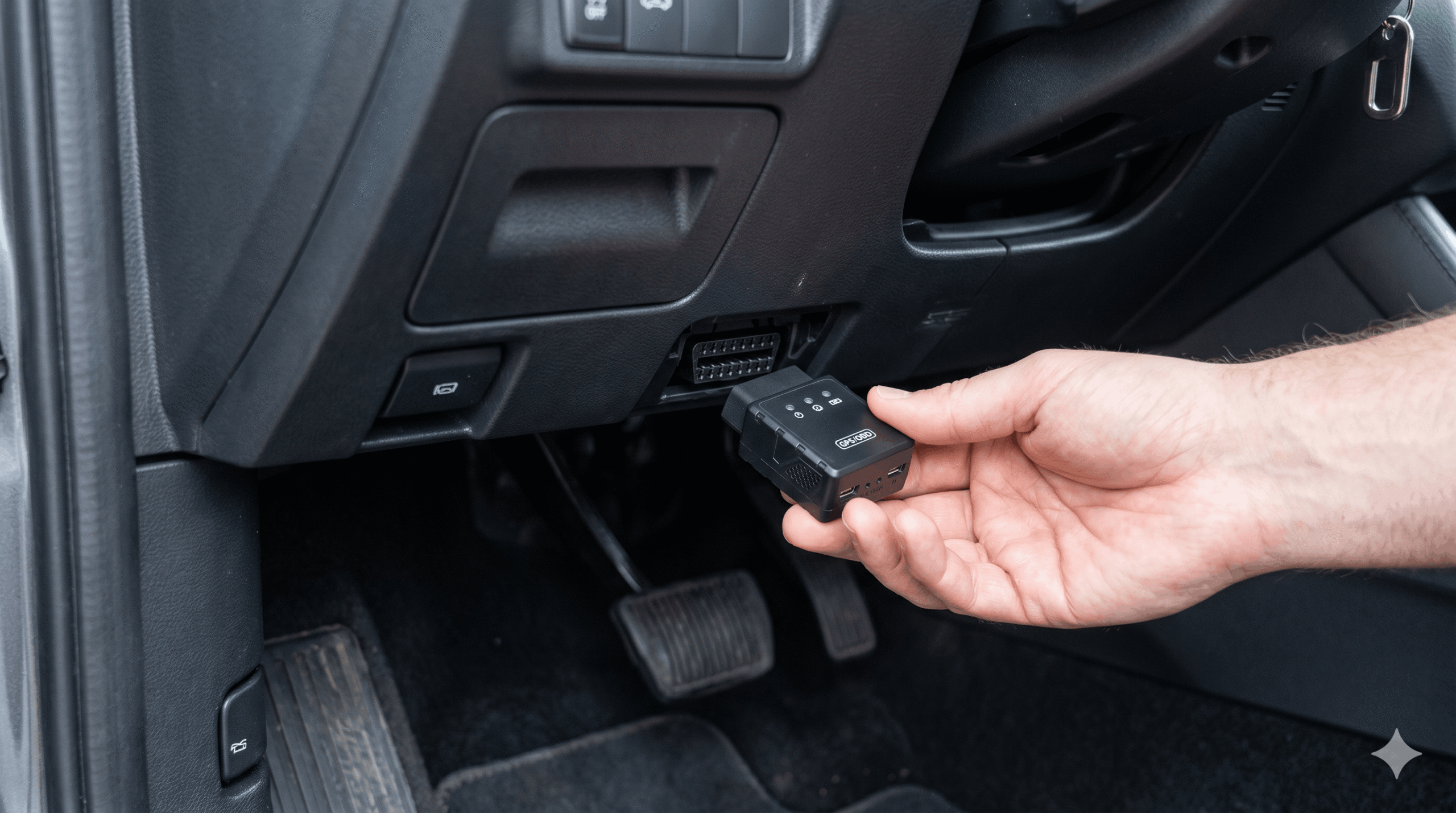
- Locate the OBD-II port: under the steering wheel on the driver's side, usually to the left of the steering column.
- Plug in the tracker directly to the OBD port: it clips in effortlessly.
- Wait 30 seconds: the tracker powers on and acquires the first GPS satellites.
- Download the EZTrack app (iOS or Android) and create your account.
- Enter the tracker's identification number (on the back of the device): your vehicle immediately appears on the map.
Consequently, in less than 5 minutes, your vehicle is geolocated in real-time, wherever it is in France or Europe.
Why have a GPS tracker? 5 good reasons
Indeed, here are the 5 main uses of a GPS tracker in 2026, whether for professional or personal use.
1. Theft Protection
First, in case of vehicle theft, you can locate it in real-time and provide its position to law enforcement. Consequently, the chances of recovery increase from 30% (without a tracker) to over 90% (with a tracker). Thus, the ROI on a €30,000 vehicle is immediate from the first use.
2. Reduce Costs for Businesses
Next, for a company fleet, the GPS tracker allows for route optimization (–15% to –25% mileage), detection of unauthorized detours, and proof of presence at the client's site. Furthermore, the average ROI for a professional tracker is observed between 4 and 8 months.
3. Real-time Geolocation
Furthermore, you can view the live position of each vehicle on an interactive map. No more need to call the driver to know their progress on their route — the information is instant and accessible 24/7.
4. Access Detailed Reports
Moreover, the GPS tracker automatically generates comprehensive reports: daily mileage, average speed, estimated consumption, driving time, zone alerts. Consequently, you have precise analysis to optimize your activity.
5. Ensure the Safety of Loved Ones
Finally, for family use, the GPS tracker allows you to locate a loved one's vehicle if needed (young driver, elderly person, spouse traveling). Thus, you have peace of mind at all times.
How to choose your GPS tracker?
First, here are the 7 essential criteria to compare before buying a GPS tracker, whether for professional or personal use.
- Mounting type: OBD, magnetic, or wired depending on your use case
- Location frequency: 10s, 30s, or 1 min depending on your temporal precision needs
- Network coverage: 2G, 4G, 5G, or multi-band for international travel
- Battery life (magnetic models): 1 month, 6 months, or 12 months
- Mobile application: iOS and Android, ergonomics, features
- All-inclusive price: hardware + subscription + SIM card + support
- Data hosting: France, EU, or outside EU (GDPR)
Therefore, take the time to compare these 7 criteria before signing. Indeed, a hasty choice can be costly in unsuitable subscription fees or missing features.
GPS Trackers: The 5 Categories of Players in the French Market
First, the French vehicle GPS tracker market has several categories of players, each targeting a specific segment. Here are the 5 types to know before choosing your provider.
- French pioneers without subscription — Specialized in individuals and anti-theft use, long-life trackers, primarily one-shot hardware sales model with low recurring revenue.
- SME fleet specialists with comprehensive SaaS (like EZTrack) — Integrated tracking solution + real-time interface + support, team and servers in France, ideal for managing 2 to 50 vehicles.
- Micro-mobility and 2-wheel players — High-end technology dedicated to scooters, cargo bikes, professional e-scooters, management of small urban fleets.
- Premium giants for large fleets — Enterprise solutions for 50+ vehicle fleets, complex integration with ERP/TMS, high prices but very advanced features.
- International SME-oriented players — Multi-country presence (often Anglo-Saxon), focus on crafts and SMEs, standardized offering less adapted to French specificities.
Indeed, your choice will depend mainly on the size of your fleet (1-5, 6-20, or 50+ vehicles) and your target monthly budget. Thus, EZTrack is particularly well-positioned in the segment of French SMEs and VSEs thanks to its simple SaaS model, its local French-speaking team, and the French hosting of your data.
Frequently Asked Questions about GPS Trackers
Is a GPS Tracker Legal in France?
Yes, a GPS tracker is completely legal in France for personal vehicles. For professional vehicles tracked by an employer, it is legal under strict CNIL conditions: prior written information of the employee, declaration in the processing register, declared legitimate purpose. Therefore, consult our CNIL employee geolocation guide 2026 for details.
Does a GPS tracker require a SIM card?
Yes, a GPS tracker requires a SIM card to transmit data to the server via the mobile network (3G or 4G LTE depending on the model). Without a SIM card, the tracker can calculate its position but cannot send it. In professional subscriptions, the M2M (multi-operator) SIM card is generally included.
Can you install a GPS tracker yourself?
Yes for OBD and magnetic trackers: plug-and-play installation in less than 2 minutes, no technical skills required. However, wired trackers require a professional installer (1-2 hours of installation, €50-€150 cost).
How accurate is a GPS tracker?
First, the standard accuracy of a professional GPS tracker is 2 to 5 meters in open areas (countryside, highway). In dense urban environments with tall buildings, it can drop to 10-20 meters due to reflections off facades. Trackers using Galileo or GLONASS in addition to American GPS offer improved accuracy.
How Long Does a Magnetic GPS Tracker's Battery Last?
First, this depends on the model and the configured transmission frequency. In standard mode (transmission every 5 minutes), expect 3 to 6 months of battery life. In power-saving mode (transmission 1-2 times a day), some models last up to 12 months.
Can a GPS Tracker Listen to Conversations?
No, standard GPS trackers do not have microphones and cannot record sound. This would be illegal in France without the explicit consent of the individuals concerned. Nevertheless, some very specific models intended for long-distance fleets may integrate a hands-free kit for communication with the driver — but this is a distinct feature and always voluntarily activated.
Can a GPS Tracker Be Deactivated?
Yes. For an OBD tracker, simply unplug it physically. For a magnetic one, simply remove the battery or move it. For a hardwired tracker, you need to access the wiring — more difficult but possible. Therefore, for professional use, wired remains the most deterrent against deactivation by the employee.
Does the GPS Tracker Work Abroad?
Yes, most professional GPS trackers work throughout Europe thanks to multi-operator SIM cards. Check with your provider for the list of covered countries. Some models even include global roaming (Africa, Asia, Americas) for international fleets.
Conclusion — Choosing the Right GPS Tracker in 2026
Indeed, the GPS tracker has become an indispensable tool, whether to secure a personal vehicle, optimize a professional fleet, or simply have peace of mind. Therefore, choosing the right model depends on your use case: OBD for professionals who want plug-and-play, magnetic for anti-theft discretion, wired for vehicles kept for a long time.
Thus, by complying with CNIL obligations and choosing the right subscription, you will benefit from a high-performing and compliant system. EZTrack offers a complete French solution designed for French SMEs and VSEs.
Ready to Protect and Optimize Your Vehicle?
Free EZTrack 15-minute demo: we'll show you live how an EZTrack GPS tracker works, the real-time interface, and the benefits for your fleet.
📞 Request a Demo 💶 View Pricing